
IEEE Milestones in the Tokyo Section
Last updated: Dec. 30, 2025
- The Pioneering TRON Intelligent House(1989)
- Pulse Oximetry(1972)
- TRON Real-time Operating System Family(1984)
- Physical Contact Push-Pull Technology For Fiber Optic Connectors(1986)
- First Commercial Digital Signal Processor Chip(1980)
- First Operational Large-Scale Latent Fingerprint Identification System(1982)
- High Electron Mobility Transistor, HEMT(1979)
- Nobeyama 45-m Telescope(1982)
- Invention of a Temperature-Insensitive Quartz Oscillation Plate(1933)
- Map-Based Automotive Navigation System(1981)
- High Definition Television System(1964 – 1989)
- Emergency Warning Code Signal Broadcasting System(1985)
- Vapor-phase Axial Deposition Method for Mass Production of High-quality Optical Fiber(1977 – 1983)
- TPC-1 Transpacific Cable System(1964)
- Gapless Metal Oxide Surge Arrester (MOSA) for electric power systems(1975)
- Line Spectrum Pair (LSP) for high-compression speech coding(1975)
- Toshiba T1100, a pioneering contribution to the development of laptop PC(1985)
- International Standardization of G3 Facsimile(1980)
- First Practical Field Emission Electron Microscope(1972)
- First Direct Broadcast Satellite Service(1984)
- First Transpacific Reception of a Television (TV) Signal via Satellite(1963)
- Development of Ferrite Materials and Their Applications(1930 – 1945)
- The First Word Processor for Japanese Language(1971 – 1978)
- Development of VHS, a World Standard for Home Video Recording(1976)
- Electronic Quartz Wristwatch(1969)
- Mount Fuji Radar System(1964)
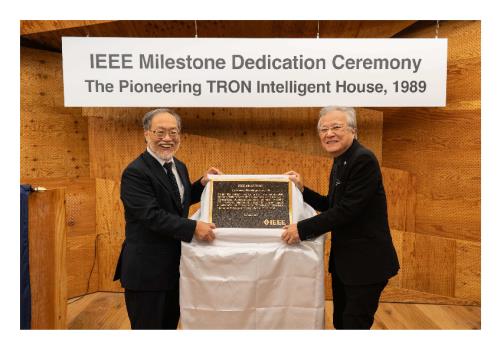 |
The first TRON Intelligent House was based on the concept of a Highly Functionally Distributed System (HFDS) as proposed in 1987. Built in Tokyo in 1989 using about 1,000 networked computers to implement Internet of Things (IoT), its advanced human-machine interface (HMI) provided “ubiquitous computing” before that term was coined in 1991. Feedback by TRON’s residents helped mature HFDS design, showing how to live in an IoT environment. |
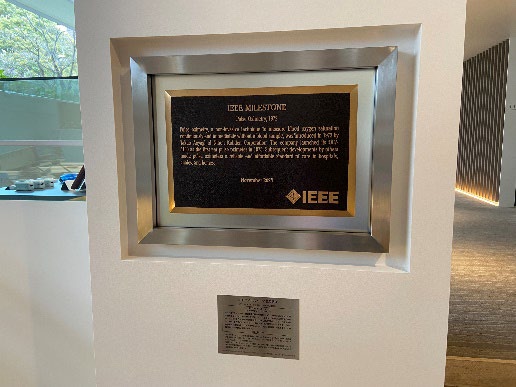 |
Pulse oximetry, a non-invasive technique to measure blood oxygen saturation continuously and immediately without a blood sample, was introduced in 1972 by Takuo Aoyagi of Nihon Kohden Corporation. The company launched its OLV-5100 as the first ear pulse oximeter in 1975. Subsequent developments by others made pulse oximeters a reliable and affordable standard of care in hospitals, clinics, and homes. |
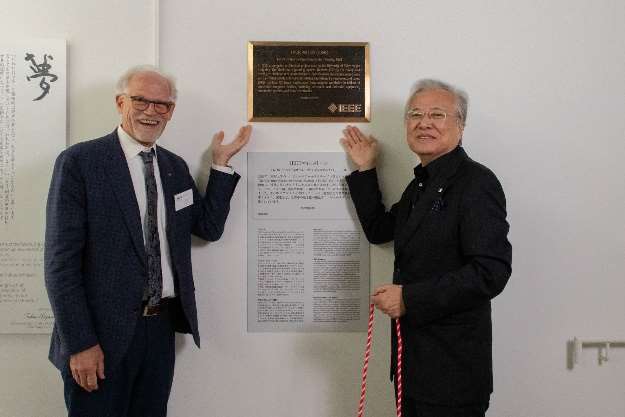 |
In 1984, a computer architecture project team at the University of Tokyo began designing The Real-time Operating system Nucleus (TRON) OS family and helping external partners commercialize it. Specifications and sample source code were provided openly and freely, facilitating innovations by developers and users. TRON real-time OS family copies have been adopted worldwide in billions of embedded computer devices, including aerospace and industrial equipment, automotive systems, and home electronics. |
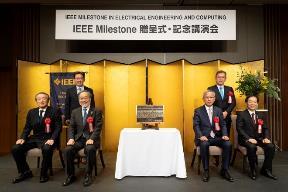 |
In 1986, Nippon Telegraph and Telephone Corp. (NTT) invented the physical contact connection technology that advanced performance and reliability of fiber optic connectors. NTT developed “Single mode optical fibers Coupling (SC)(or shortly called “Subscriber Connector”), and Multiple fiber Push-On /Pull-Off(MPO) connectors”; their compactness and simple push-pull operation were major advantages. Widely adopted by carriers and data centers since 1990, this technology facilitated the construction of systems for near light-speed, digital, global communications. |
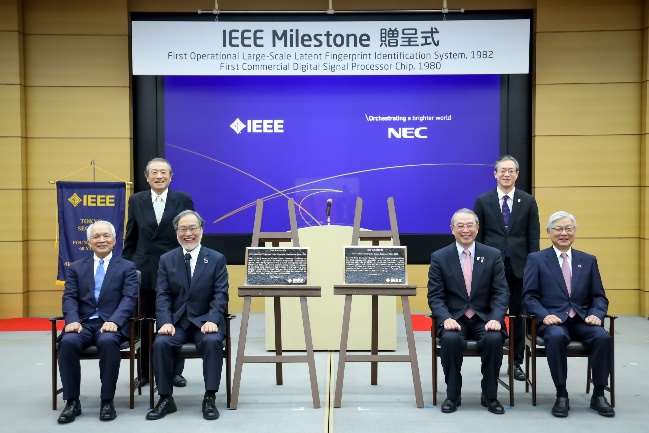 |
In 1980, NEC (formerly Nippon Electric Company) developed here the first commercially available, programmable digital signal processor chip, μPD7720. Its novel bus structure, 250-nsec instruction cycle, and 16-bit multiplier enable fast finite impulse response filtering and provided true real-time processing for complex systems. It accelerated the adaptation of digital signal processing in communications and broadcasting. |
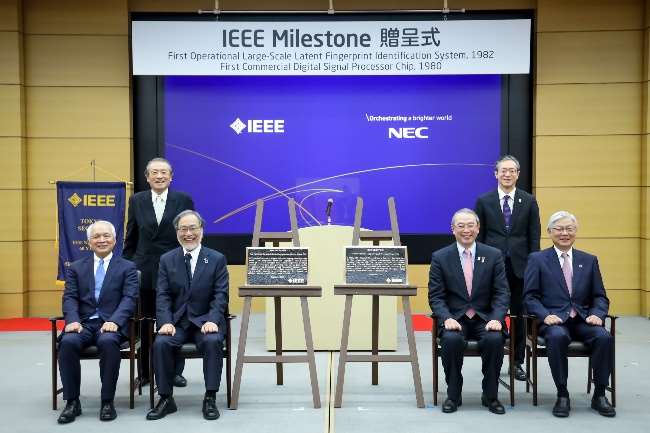 |
NEC, formerly known as Nippon Electric Company, introduced the world’s first large-scale automated fingerprint identification system (NEC AFIS) equipped with a latent fingerprint matching function in 1982. This was a powerful crime-solving tool capable of matching even fragmented latent fingerprints against a large database, a task that previously had been impossible. It enabled the world’s police agencies to expedite searches for suspects, an efficiency that many public-safety experts valued. |
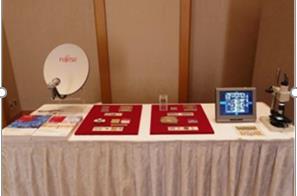 |
The HEMT, invented in 1979, was the first transistor to incorporate an interface between two semiconductor materials with different energy gaps. HEMT proved superior to previous transistor technologies due to high mobility of channel carriers, resulting in high speed and high frequency performance. HEMTs have been widely used in radio telescopes, satellite broadcasting receivers and cellular base stations, giving rise to a fundamental technology supporting the information and communication society. |
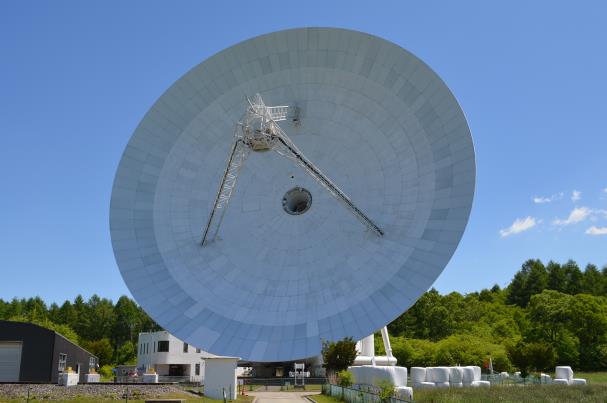 |
In 1982, the Tokyo Astronomical Observatory in collaboration with Mitsubishi Electric Corporation completed the 45-m telescope as the world’s largest antenna for millimeter-wave radio astronomy. The 45-m telescope’s innovative engineering contributed to the progress of radio astronomy by enabling high-resolution and high-sensitivity observations. Notable discoveries included new interstellar molecules and a black hole. |
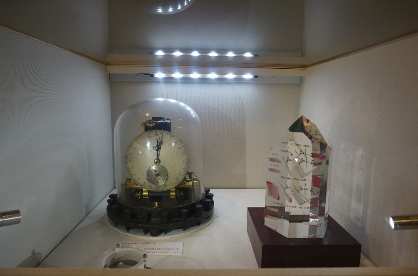 |
In April 1933, Issac Koga of the Tokyo Institute of Technology reported cutting angles that produced quartz crystal plates having a zero temperature coefficient of frequency. These angles, 54⁰ 45’ and 137⁰ 59’, he named the R1 and R2 cuts. Temperature-insensitive quartz crystal was used at first for radio transmitters and later for clocks, and has proven indispensable to all radio communication systems and much of information electronics. |
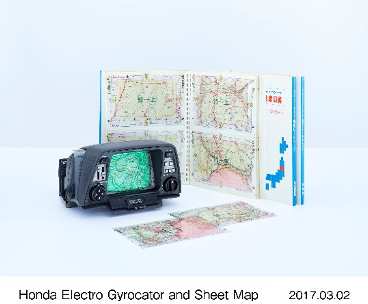 |
The world’s first map-based automotive navigation system, ‘Honda Electro Gyrocator’, was released in 1981. This system was based on inertial navigation technology using mileage and gyro sensors. It pioneered the display on board of the destination path of a moving vehicle on overlaying transparent roadmap sheets, and contributed to the advancement of automotive navigation systems. |
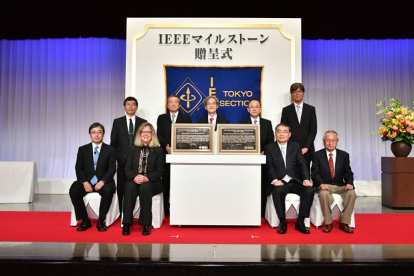 |
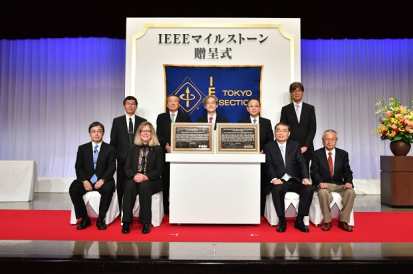
NHK (Japan Broadcasting Corporation) developed high-definition television (HDTV), a high-resolution and wide-screen television system designed to convey a strong sense of reality to viewers. Research began in 1964, ranging from psychophysical experiments to system development. In 1989, the world’s first HDTV broadcast via satellite opened a new era in broadcasting. Since 1989, HDTV has spread throughout the world. |
 |
NHK (Japan Broadcasting Corporation) began broadcasting emergency warning code signals in 1985. The system embedded signals within AM and FM radio broadcasts that provided reliable and prompt transmission of emergency warning information to the public. During the course of digital TV standardization, the warning codes were integrated into technical standards of international satellite and terrestrial broadcasting. |
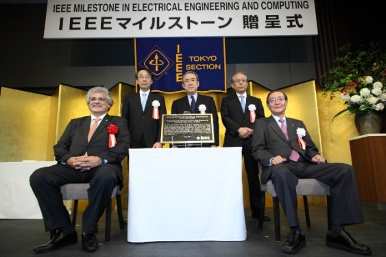 |
In 1977, Dr. Tatsuo Izawa of Nippon Telegraph and Telephone Corp. (NTT) invented the vapor-phase axial deposition (VAD) method suitable for the mass production of optical fiber. NTT, Furukawa Electric, Sumitomo Electric, and Fujikura collaboratively investigated the fabrication process. The technology successfully shifted from research and development to commercialization. The VAD method contributed greatly to the construction of optical-fiber networks. |
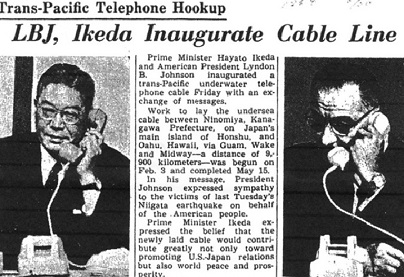 |
The transpacific undersea coaxial telephone cable system linking Japan, Hawaii, and the U.S. mainland became operational in 1964. President Lyndon Johnson and Prime Minister Hayato Ikeda inaugurated this communications link on 19 June 1964. The joint project involving American Telephone and Telegraph, Hawaiian Telephone Company, and Kokusai Denshin Denwa improved global communication and contributed to deep-water submarine cable technologies. |
 for electric power systems.jpeg "The world’s first zinc oxide arrester at Kyushu Electric Power, Hayato Substation") |
Meidensha Corporation developed MOSA and its mass production system by innovating on Panasonic Corporation’s ZnO varistor basic patent. MOSA dramatically raised performance levels against multiple lightning strikes and contamination, and led to UHV protective device development. This technology contributed to improving the safety and reliability of electric power systems and to establishing international standards. |
 for high-compression speech coding.jpeg "Unoura, President, NTT received the plaque from J.Roberto de Marca, IEEE President") |
Line Spectrum Pair, invented at NTT in 1975, is an important technology for speech synthesis and coding. A speech synthesizer chip was designed based on Line Spectrum Pair in 1980. In the 1990s, this technology was adopted in almost all international speech coding standards as an essential component and has contributed to the enhancement of digital speech communication over mobile channels and the Internet worldwide. |
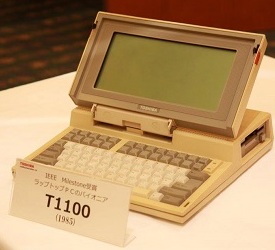 |
The Toshiba T1100, an IBM PC compatible laptop computer that shipped in 1985, made an invaluable contribution to the development of the laptop PC and portable personal computers. With the T1100, Toshiba demonstrated and promoted the emergence and importance of true portability for PCs running packaged software, with the result that T1100 won acceptance not only among PC experts but by the business community. |
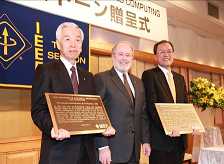 |
At this site, the two-dimensional coding MR (Modified READ) method for G3 facsimile was developed through the careful collaboration of NTT and KDDI. It was the most innovative, efficient method, and was key to the success of international standardization. Strong Japanese leadership with intense international discussions and examinations yielded the G3 facsimile recommendation in 1980 to conclude international standardization efforts for redundancy suppressing digital facsimile. |
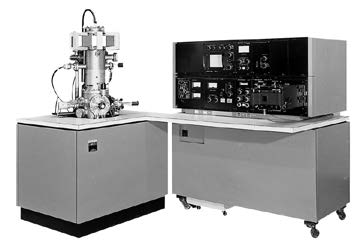 |
Hitachi developed practical field emission electron source technology in collaboration with Albert Crewe of the University of Chicago, and commercialized the world’s first field emission scanning electron microscope in 1972. This technology enabled stable and reliable ultrahigh resolution imaging with easy operation. Field emission electron microscopes have made invaluable contributions to the progress of science, technology and industry in physics, biology, materials, and semiconductor devices. |
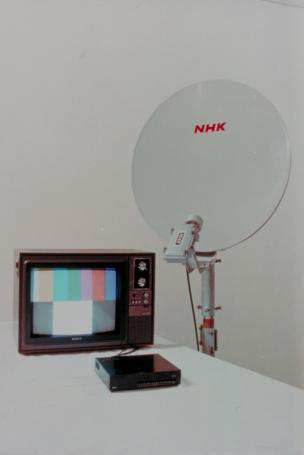 |
NHK began the world’s first direct broadcast satellite service in May, 1984. This was the culmination of eighteen years of research that included the development of an inexpensive low-noise receiver and investigations of rain attenuation in the 12 GHz band. RRL, NASDA, TSCJ, Toshiba Corporation, General Electric Company, and NASA participated with NHK to make satellite broadcasting to the home a practical reality. |
 Signal via Satellite.jpg "Cassegrain antenna of the former Ibaraki Satellite Communication Center (currently used for radio astronomy)") |
On 23 November 1963, this site received the first transpacific transmission of a TV signal from Mojave earth station in California, U.S.A., via the Relay 1 communications satellite. The Ibaraki earth station used a 20m Cassegrain antenna, the first use of this type of antenna for commercial telecommunications. This event demonstrated the capability and impact of satellite communications and helped open a new era of intercontinental live TV programming relayed via satellite. |
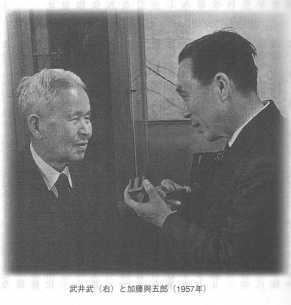 |
In 1930, at Tokyo Institute of Technology, Drs. Yogoro Kato and Takeshi Takei invented ferrite, a magnetic ceramic compound containing oxides of iron and of other metals with properties useful in electronics. TDK Corporation began mass production of ferrite cores in 1937 for use in radio equipment. The electric and electronics industries use ferrites in numerous applications today. |
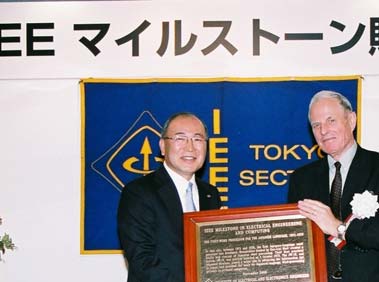 |
At this site, between 1971 and 1978, the first Japanese-language word processor was developed. Researchers headed by Ken-ichi Mori created a wholly new concept of Japanese word processing. Their first practical system, JW-10, was publicly unveiled on 3 October 1978. The JW-10, and improved versions, played a major role in advancing the Information Age in Japan and provided the basis for Japanese-language word-processing software in personal computers. |
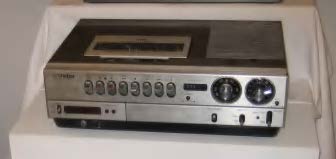 |
At the Yokohama Plant of Victor Company of Japan, Limited, a team of engineers headed by Shizuo Takano and Yuma Shiraishi developed VHS (Video Home System) format. They looked ahead to the need for home video tape recorders and embodied their idea in unique inventions. The first model JVC HR-3300 was announced on 9 September 1976. Their basic design with subsequent improvement gained wide customer acceptance. VHS became the world standard for home video tape recorders. |
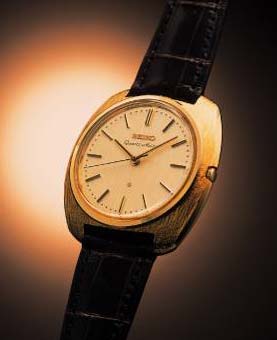 |
After ten years of research and development at Suwa Seikosha, a manufacturing company of Seiko Group, a team of engineers headed by Tsuneya Nakamura produced the first quartz wristwatch to be sold to the public. The Seiko Quartz Astron 35SQ was introduced in Tokyo on 25 December 1969. Crucial elements included a quartz crystal oscillator, a hybrid integrated circuit, and a miniature stepping motor to turn the hands. It was accurate to within five seconds per month. |
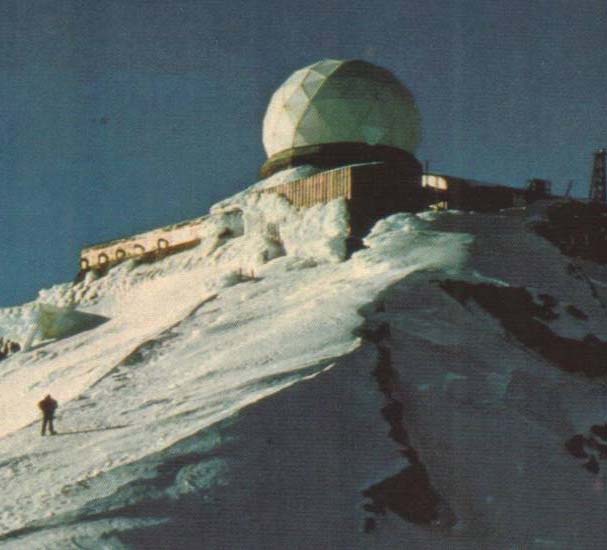 |
Completed in 1964 as the highest weather radar in the world in the pre-satellite era, the Mount Fuji Radar System almost immediately warned of a major storm over 800 km away. In addition to advancing the technology of weather radar, it pioneered aspects of remote-control and low-maintenance of complex electronic systems. The radar was planned by the Japan Meteorological Agency and constructed by Mitsubishi Electric Corporation. |